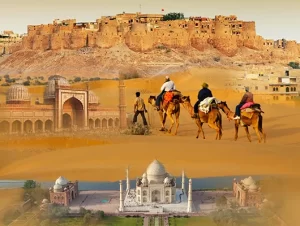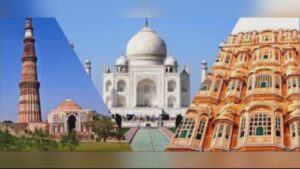
If you’ve started planning a trip to India, chances are the classic Golden Triangle tour ? Delhi, Agra, and Jaipur ? is already on your itinerary. It’s the most popular circuit in the country for good reason: the Taj Mahal, Amber Fort, and Delhi’s Mughal monuments deliver on every promise. But here’s the honest truth many first-time visitors don’t hear until it’s too late ? the Golden Triangle alone only shows you one side of India. It’s the Mughal and Rajput side: forts, palaces, and marble mausoleums.
To see the other side ? the spiritual soul of the country and one of its greatest artistic achievements ? you need to add Varanasi and Khajuraho to your Golden Triangle tour. These two destinations aren’t add-ons for the sake of it. They round out an India trip that would otherwise feel incomplete, and they’re far easier to reach from Delhi and Agra than most travelers assume.
This guide breaks down exactly why these two cities are worth the extra days, how to fit them into your route, and what to expect when you get there.
What Is the Golden Triangle Tour, Exactly?
The Golden Triangle refers to the triangular route connecting three cities in northern India:
- Delhi ? the capital, blending Mughal-era monuments with colonial and modern India
- Agra ? home to the Taj Mahal and Agra Fort
- Jaipur ? Rajasthan’s “Pink City,” known for its forts and palaces
These three cities form a compact, well-connected loop, which is exactly why the route became the standard introduction to India for international travelers. It’s efficient, it’s scenic, and it hits the highlights. But efficiency has a trade-off: the Golden Triangle shows you monuments built by emperors and kings. It doesn’t show you how ordinary Indians have lived, worshipped, and created for thousands of years.
That’s where Varanasi and Khajuraho come in.
Why Varanasi Belongs on Your Itinerary
The Oldest Living City on Earth
Varanasi (also called Kashi or Benares) is widely considered one of the oldest continuously inhabited cities in the world, with a spiritual history stretching back thousands of years. Unlike Delhi, Agra, or Jaipur ? all shaped primarily by royal dynasties ? Varanasi’s identity comes from something older and less tangible: an unbroken tradition of pilgrimage, ritual, and devotion along the banks of the Ganges.
For travelers who’ve spent days touring forts and tombs, Varanasi is a shift in register. It isn’t a monument you walk through and photograph. It’s a living, breathing ritual city where daily life and spiritual practice are inseparable.
The Ganga Aarti and Boat Ride Experience
The single most requested experience for anyone adding Varanasi to a Golden Triangle tour is the Ganga Aarti ? the evening fire ceremony performed on the ghats of the Ganges, where priests offer synchronized prayers with lamps, incense, and chanting to the river. It’s visually stunning and, for many travelers, one of the most memorable few hours of their entire India trip.
Just as popular is the early-morning boat ride on the Ganges, when the ghats are bathed in soft light and the city goes about its rituals ? bathing, prayer, and everyday routine ? right along the water’s edge.
A Day Trip to Sarnath
Most Varanasi itineraries also include a half-day excursion to Sarnath, the site where the Buddha is believed to have delivered his first sermon after attaining enlightenment. For travelers interested in Buddhist history, this is a rare opportunity to pair a major Hindu pilgrimage center with a foundational Buddhist site, all within the same short trip.
Why Khajuraho Belongs on Your Itinerary
A UNESCO World Heritage Site Unlike Anything Else in India
Khajuraho is home to one of India’s most extraordinary architectural achievements: a group of temples built by the Chandela dynasty, mostly between the 10th and 11th centuries. Of the temples originally constructed, roughly two dozen survive today, and they’re recognized collectively as a UNESCO World Heritage Site.
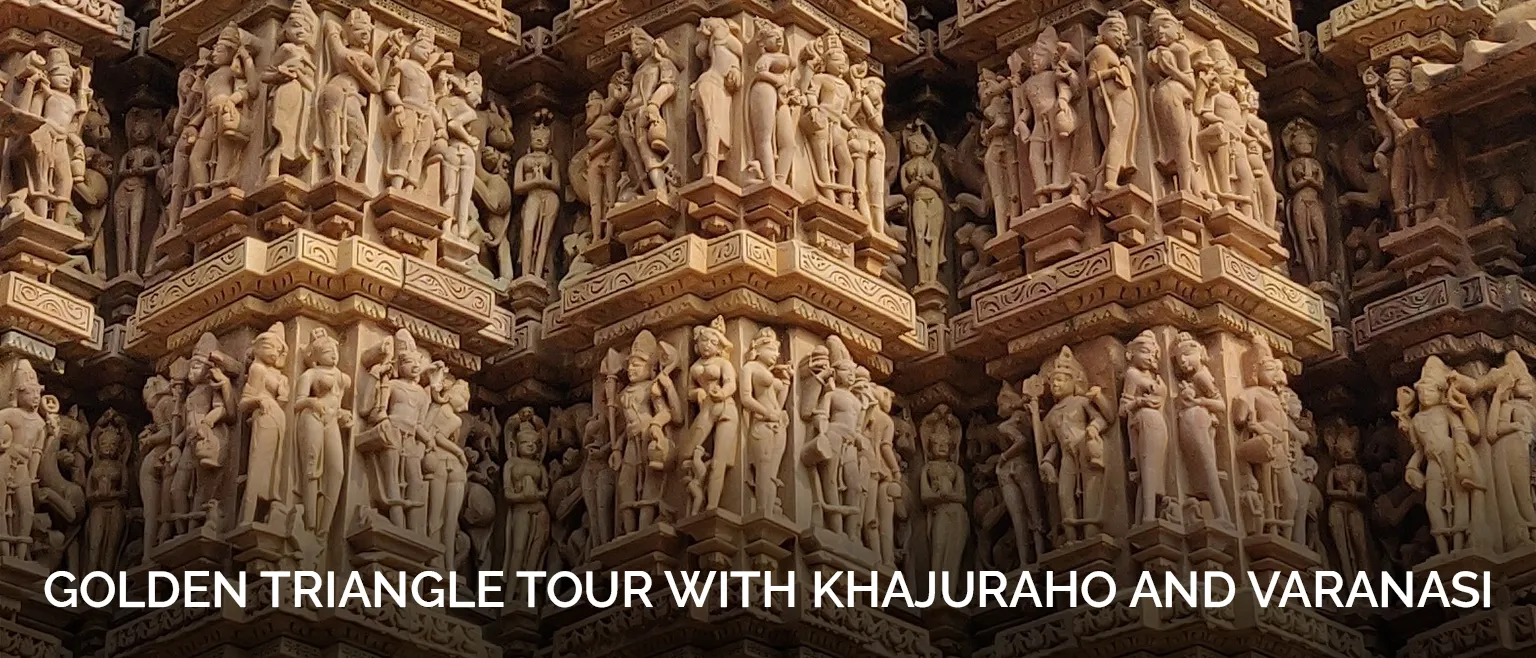
What makes Khajuraho different from Agra Fort or Jaipur’s City Palace is the sheer intricacy of the stone carving. Every surface ? walls, pillars, ceilings ? is covered in detailed sculpture depicting gods, celestial dancers, warriors, animals, and daily life. The temples are frequently compared to Cambodia’s Angkor Wat in terms of scale and ambition, though the carving style is distinctly its own.
The Erotic Sculptures ? And Why They’re Only Part of the Story
Khajuraho is famous internationally for its erotic sculptures, which have made it something of a bucket-list curiosity for travelers. But it’s worth setting expectations correctly: these carvings make up a relatively small percentage of the total artwork on the temples. The majority of the sculpture depicts mythology, royal court life, and religious themes. Visitors expecting only erotica are often surprised by how much artistic and historical depth the complex actually offers ? depictions of dance, music, warfare, and everyday life carved with equal precision.
A Remote Location That Preserved the Art
Because Khajuraho sits in a relatively remote part of Madhya Pradesh, far from the major invasion routes of medieval India, its temples avoided much of the destruction that damaged monuments elsewhere in the country. That relative isolation is precisely why the carvings remain so sharp and well-preserved today ? and why the site rewards travelers willing to make the extra journey.
How to Add Varanasi and Khajuraho to a Golden Triangle Tour
The good news: this extension is a well-established route, not an obscure detour. Most tour operators offer it as a standard package, typically adding somewhere between 4 and 7 extra days to a classic 5-6 day Golden Triangle itinerary.
A typical extended route looks like this:
- Delhi → Jaipur → Agra (the standard Golden Triangle)
- Agra → Jhansi by train, then Jhansi → Orchha → Khajuraho by road (roughly 3-4 hours’ drive, often with a stop to explore Orchha’s forts and temples along the way)
- Khajuraho → Varanasi by short domestic flight (the most time-efficient connection between the two)
- Varanasi → Delhi by flight for departure, or to continue your trip
Because Khajuraho has its own domestic airport with regular flight connections to Varanasi and Delhi, this extension is far more convenient than it sounds on paper. You’re not adding grueling travel days ? you’re adding one scenic overland journey (Agra to Khajuraho via Orchha) and one short flight.
Sample Extended Itinerary (10-11 Days)
| Day | Destination | Highlights |
| 1-2 | Delhi | Red Fort, Qutub Minar, Humayun’s Tomb, Old Delhi |
| 3-4 | Jaipur | Amber Fort, City Palace, Hawa Mahal |
| 5-6 | Agra | Taj Mahal, Agra Fort, Fatehpur Sikri |
| 7 | Orchha | Jahangir Mahal, Orchha Fort |
| 8 | Khajuraho | Western and Eastern Group of Temples |
| 9-10 | Varanasi | Ganga Aarti, boat ride, Sarnath day trip |
| 11 | Departure | Fly back to Delhi for onward travel |
Is It Worth the Extra Time and Cost?
This is the practical question every traveler asks, and it’s a fair one. Extending your trip means more days, an extra domestic flight, and additional hotel nights. Here’s how to think about it:
- If your only goal is to see the Taj Mahal and check India off a list, the classic Golden Triangle is enough.
- If you want to understand India ? its spiritual traditions, its artistic range, and the diversity of experience beyond royal architecture ? Varanasi and Khajuraho aren’t optional extras. They’re arguably the two destinations that make the difference between a tour of monuments and a genuine introduction to the country.
Many returning travelers say the same thing in different words: Delhi, Agra, and Jaipur showed them what emperors built. Varanasi and Khajuraho showed them what the culture actually believes and creates.
Best Time to Visit
Both destinations pair naturally with the same travel window as the rest of the Golden Triangle: October through March, when daytime temperatures are comfortable and humidity is low. Varanasi’s ghats and Khajuraho’s open temple courtyards are both far more enjoyable to explore outside the peak summer heat (April?June) and the monsoon season (July?September).
Practical Tips for the Extension
- Book domestic flights early. The Khajuraho?Varanasi and Varanasi?Delhi sectors have limited daily flights, and seats fill up quickly during peak season (October?March).
- Pack for early mornings. The best experiences in both cities ? the Varanasi boat ride and the quieter early hours at the Khajuraho temples ? happen before the crowds and the heat arrive.
- Hire a local guide in Khajuraho. The symbolism carved into the temples is dense and easy to miss without context; a guide transforms the visit from sightseeing into genuine understanding.
- Approach Varanasi with an open mind. It’s a sensory, crowded, sometimes chaotic city ? very different from the more polished tourist infrastructure of Agra and Jaipur. That’s part of what makes it real.
Final Thoughts
Adding Varanasi and Khajuraho to your Golden Triangle tour turns a well-executed sightseeing trip into a far more complete picture of India ? one that includes not just its royal history, but its spiritual life and artistic imagination as well. The logistics are simpler than they look, the extension is a well-trodden route with reliable flight connections, and the payoff ? a sunrise boat ride on the Ganges, an evening Aarti, and a walk through the carved corridors of Khajuraho’s temples ? is the kind of experience most travelers say they remember longer than the Taj Mahal itself.
If you’re already planning the trip, the real question isn’t whether you have time for Varanasi and Khajuraho. It’s whether you want to leave India having only seen half the story.
Frequently Asked Questions
How many extra days do I need to add Varanasi and Khajuraho to a Golden Triangle tour?
Most itineraries add 4-6 extra days to the standard 5-6 day Golden Triangle, bringing the full trip to around 10-11 days.
How do I travel between Khajuraho and Varanasi?
The most common option is a short domestic flight, which takes a little over an hour and is far faster than the overland alternative.
Are the Khajuraho temples only known for erotic carvings?
No. Erotic sculptures make up a small portion of the artwork; the majority depicts mythology, royal life, dance, and everyday scenes from the Chandela era.
What is the best time of year for this extended tour?
October through March offers the most comfortable weather for both the Golden Triangle cities and the Varanasi/Khajuraho extension.
Do I need a guide in Varanasi or Khajuraho?
It’s not mandatory, but strongly recommended ? especially in Khajuraho, where a guide can explain the symbolism behind the carvings that’s easy to miss on your own.